In 2019, I was given an interesting challenge: come up with a name and brand identity for an embryonic movement I had helped co-found. That movement became Catalyst 2030 (now Catalyst Now), a global network of social innovators. A serendipitous consequence of that work was the birth of LESA Communications.
But to understand LESA, you need to understand what came before it and it might not seem obvious.
Twenty five years in African communities
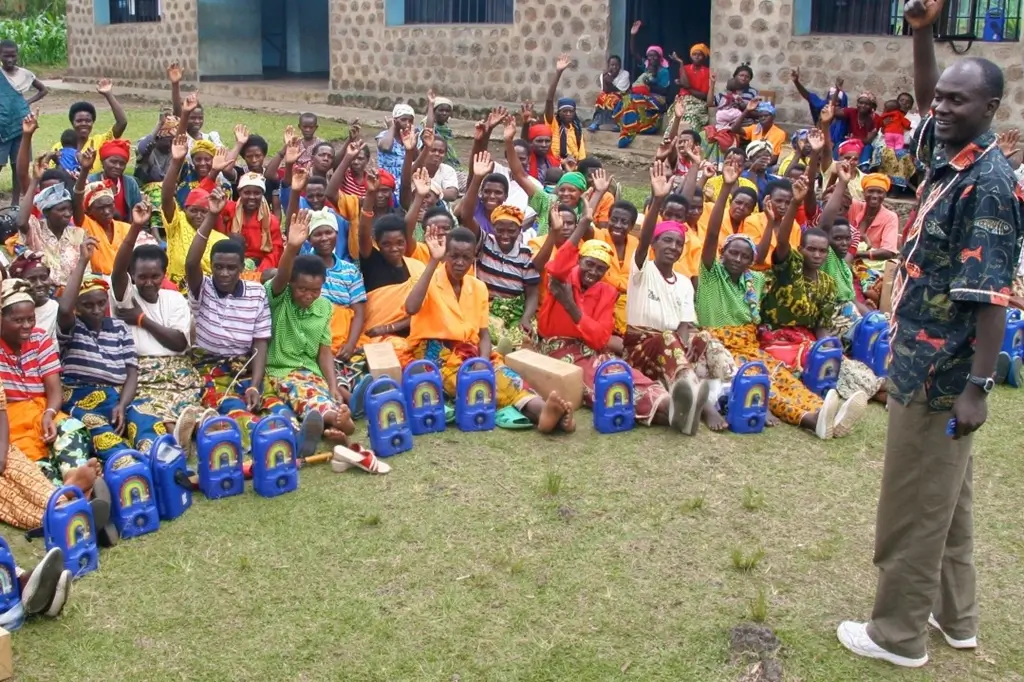
For over two decades, my work has been rooted in African rural communities through Lifeline Energy, a social enterprise I founded in the late 1990s. Working alongside local NGOs and international aid organisations, we focused on education, agriculture, health and economic development, arming communities and schools with solar and wind-up radios and MP3 players so that learning and information could flow 24/7, regardless of whether the grid reached them. More than distributing devices, we invested in people by training local trainers to use and maintain the technology themselves.

The power of communication became obvious to me almost immediately especially when it was paired with community radio. I watched our radios become a megaphone for communities that had been systematically shut out: people voicing concerns in their own languages, exchanging vital information, driving development from the inside. Women’s voices, especially, were being heard in ways they never had been before.
The 1990s and 2000s saw an explosion of African community radio stations, supported by organisations like BBC Media Action, Farm Radio International and Internews, who trained community members as journalists, producers and writers. Professionals from national broadcasters like Radio Mozambique, the Kenya Broadcasting Corporation and others contributed to that wave of capacity-building.
When good money produces bad communication
But I also saw the other side of it. Alongside the good was a great deal of well-funded, well-intentioned communication that entirely missed its audience.
A US government-funded company created an English language series for South Sudanese communities, set in a fictitious, trendy coffee shop in Juba around 2010. Cappuccinos. Debit card payments. For the world’s poorest and least literate country. A British NGO produced a multi-country English language lesson series set in London’s Victoria Station. This was totally bizarre for people whose daily reality was the search for clean drinking water, not the 10:15 to Bristol. Millions were spent. Few, if anyone, benefitted.
I also witnessed the real danger of bad communication. During an Ebola outbreak along the Uganda-South Sudan border, pictorial information posters were everywhere. Ubiquitous, created by international agencies and in English, and absurd because most people in those communities did not speak. Plus the imagery was confusing.
Across the continent, I have seen vital health posters produced in English or French for audiences who use neither, featuring people who look nothing like the communities they are meant to reach. Whenever I have worked on posters or instructions for local initiatives, I have learned to involve local cartoonists from the start. They understand how people will read and relate to messages. In a development context, poor communication is not just a waste of money. It can be a matter of life or death.
The moment that changed everything
In mid-2019, I was in a Zoom call with a mosaic of social entrepreneur faces when Jeroo Billimoria , the de facto founder of what would become a significant global movement, challenged me to name it. Working with the other co-founders, we landed on Catalyst 2030 (now Catalyst Now). The Lifeline Energy team, which quietly became the LESA Communications team in the process, went on to create the tagline, brand colours, identity guidelines and a starter website, all before its launch at the World Economic Forum in Davos in January 2020. Much of that creative work belongs to our Creative Director, Karen Vollaire.
LESA was not planned, or even well-thought-through at that point. It was the natural outcome of years of learning about what communication can do when it is done well and what it costs when it is not.
What LESA is, and why it exists
Our team is all-women and draws largely from across the Global South, including professional writers, designers, editors, developers and media specialists who care about the work, not just the output. Each is outstanding at what they do. LESA sits at the intersection of communications craft and deep ecosystem knowledge. We understand social innovation, entrepreneurship and what it takes to build something real in contexts that most global agencies do not know and do not ask about.
Radio remains the most widely used communication medium across Africa, the grandmother of the continent’s media landscape and still rocking the airwaves. But no single technology serves all needs. Effective communication means thoughtfully matching the right message to the right medium for the right audience. That ability to read context and make that connection is LESA’s core strength. I think of us more like an orchestra. We play all the instruments, and we know which ones to play for whom.
We thrive in the social innovation and entrepreneurial space. This is where Africa’s new narratives are being written and we are here for it.